
Households with only one employed person can be considered to be somewhat vulnerable. Their proportion is rising. Also rising is the proportion of highly vulnerable households with no person employed, observes Mahesh Vyas.

The government should end subsidised domestic cooking gas (LPG) for people with income of more than Rs 6 lakh per annum, a Parliamentary Panel has suggested.

'The Indian economy has been subsidised by the poor.'
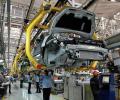
The K-shaped economic recovery in India from the pandemic slowdown shows in corporate results as well. The automobile sector, which represents big-ticket consumption, continues to do well and has increased its share in corporate revenues and profits while fast-moving consumer goods (FMCG) companies that sell low-ticket consumer goods are struggling with poor sales and earnings growth. The share of the automobile sector, including makers of auto ancillaries, in corporate net sales rose to a 10-quarter high of 10.05 per cent during July-September 2023 (Q2FY24) from 8.94 per cent a year earlier and 9.75 per cent in Q1FY24.

Finance Minister Nirmala Sitharaman on Tuesday said the securities transaction tax (STT) will be increased on futures and options (F&O) trade from October 1 to discourage retail investors from investing in the risky instrument.
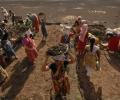
80% of the surveyed districts did not show any change in migration

The prime minister recalled the innumerable every day adversities that his mother encountered and successfully overcame.

More than 127 million new bank accounts have been opened.
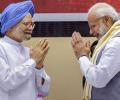
In a scathing attack on Prime Minister Narendra Modi, former prime minister Manmohan Singh on Thursday accused him of lowering the dignity of public discourse and the gravity of the office of the PM by giving "hateful speeches" during the poll campaign.

The searing heat pushed the city's peak power demand to its highest for May, while the Delhi government directed the schools that have not closed for summer vacations to do so with immediate effect.
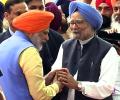
Whether it was the MGNREGS or the NFSA or the Aadhaar-based DBT scheme for cash transfer, the Modi government has built on the basic architecture created by the Singh government. Policy makers in the Modi government, instead of discarding them as products of the previous political regime, worked on them, expanded their scope and reach, and used new tools to improve their performance, explains A K Bhattacharya.

While movie stars like Akshay Kumar, Amitabh Bachchan and Salman Khan are among the top I-T payers, very few of the wealthiest Indians figure on the list.

'What happens in the real estate market is that once the prices go up it goes on to stay at that level.' 'It might not increase and at the same time the prices will not come down too.'

FMCG major Hindustan Unilever on Wednesday reported a 1.53 per cent decline in consolidated net profit to Rs 2,561 crore for the fourth quarter ended March 31, 2024 due to factors such as deflation and softening of commodity prices. The company had posted a net profit of Rs 2,601 crore in the year-ago period, according to a regulatory filing from HUL. Net sales of Hindustan Unilever Ltd (HUL) were almost flat to Rs 15,013 crore in the March quarter.

Less than nine per cent of Chhattisgarh households got jobs for 100 days under Mahatma Gandhi National Rural Employment Guarantee Act during 2007-08 to 2011-12, a Comptroller and Auditor General report tabled in the assembly on Wednesday said.

The survey, however, said that GDP is expected to revert to growth terrain next year, when it is likely to grow by 7.2 per cent.

People who are close to retirement and don't intend to go back to full-time work again should deploy a part of their VRS money in equities so that it keeps growing at a faster rate.

'The consensus was that the debate was between looking backward and looking forward.' 'Trump, with his great enamourment of his own 'achievements,' was obviously looking backward, while Harris, nearly 20 years his junior, was focussing on the future, with hope,' notes Shreekant Sambrani.

Begin by creating a household budget. Involve all family members in the exercise and cut costs wherever possible.

Claims of a spike in poverty and inequality in India during the Covid-19 pandemic are patently false as such claims are based on uncomparable different surveys, according to a paper co-authored by eminent economist Arvind Panagariya. The paper also noted that inequality fell in the country during Covid years, both in rural and urban areas as well as nationally. Panagariya, Columbia University Professor and former vice chairman of NITI Aayog and Vishal More of Intelink Advisors, New Delhi have co-authored a detailed paper 'Poverty and Inequality in India: Before and After Covid-19'.

The slowdown in corporate revenue growth over the last one year has begun to reflect in India Inc's capital expenditure, or capex. The country's top listed companies are going slow on fresh investment in capacity expansion, in line with a deceleration in their top line growth. The combined fixed assets of the listed companies, excluding banking, finance services and insurance (BFSI) and the government-owned oil & gas firms, were up 10.1 per cent year-on-year (Y-o-Y) during April-September 2023 (H1FY24) - the slowest in 18 months - as against 21.1 per cent Y-o-Y growth in H2FY23 (October 2022-March 2023) and 11.6 per cent growth in the April-September 2022 period (H1FY23).

Could the MPCE survey results be used as a basis of reconstructing the Consumer Price Index with new weights, asks Madan Sabnavis.
Companies manufacturing fast-moving consumer goods (FMCG) continue to see rural stress sustain and it continues to trail urban demand. At the Confederation of Indian Industry's FMCG summit, managements of various companies pointed out urban demand continued to grow while rural demand remained under pressure because incomes were under stress in rural areas. "Due to rural stress, volumes continue to remain an issue for the industry and we are yet to see any revival in demand," Sudhir Sitapati, managing director (MD) and chief executive officer (CEO) at Godrej Consumer Products

'To bring about a paradigm shift in farmers's income, we need to change our approach to agriculture, and transit from the narrow prism of cultivation to a full-fledged enterprise, by building all associated supply chain linkages.' 'This alone will make the farmer an entrepreneur in his own right.'

Life Insurance Corporation of India (LIC) February 8 for the first time ever crossed the Rs 7 trillion market capitalisation, as the stock price of state-owned insurer hit a new high of Rs 1,144,45, on rallying 10 per cent on the BSE. The board of directors of the Corporation are scheduled to meet today i.e. February 8, 2024, to consider a proposal for declaration of interim dividend for the financial year 2023-24 (FY24). The board will also consider and approve the unaudited financial results for the quarter and nine-month period ended on December 31, 2023.

We asked colleagues, present and past, to reflect on a man who has made such a difference to their lives and careers. Here it is then, a rich collection of memories that offer enchanting glimpses of the enigmatic Ajit Balakrishnan.
Household income in India, which had only about seven million private cars in 2004, is advancing at a two-digit pace
The report profiled the four largest immigrant communities -- Indians, Mexicans, Chinese and Vietnamese. It found that although three-quarters of the Indian population was born abroad, they own the most valuable home of about median home price of $860,000 (about Rs 3.4 crore), compared with the county's price of $743,000 (about Rs 2.9 crore).

Critics said a 10-plus per cent annual increase in incomes is a tall order, given that between 2002-03 and 2012-13, farm incomes grew yearly by 3.6 per cent.

'If we want real democracy, the economy itself will need to be democratised.'
India's festival season is bound to leave behind a bitter taste for the common people with prices of several commodities skyrocketing.

Temperatures remained above 45 degrees Celsius in large parts of Rajasthan, Haryana, Delhi, Chandigarh and Uttar Pradesh, affecting daily life as many chose to remain indoors in the afternoon.

'When you do some job for a few hours, you are hardly earning enough to survive.'
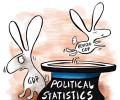
The Economic Survey 2022-23 (FY23), to be presented a day before Union Budget 2023-24 (FY24), is likely to project India's real gross domestic product (GDP) growth between 6 per cent and 7 per cent for FY24, Business Standard has learnt. The broader theme of the Survey could be on how India has dealt with two years of a global pandemic and the ongoing geopolitical disturbance, the strengths and weaknesses that emerged, and what lessons may be learnt. The much-awaited Survey will be the first one by Chief Economic Advisor V Anantha Nageswaran and his team in the finance ministry's economic division.

Make financial planning a part of your education and definitely a part of your marriage, says financial planner Sheetal Jhaveri.

If you have been planning to buy a house, don't postpone your purchase. Developers are offering discounts, freebies and attractive payment plans.

'The household sector, which is still the largest contributor of financial savings, has been experiencing a decline in the last six years, and it has fallen below 8% of GDP.'

He also said the mandate given by the people is to give a pro-people administration and not for "enjoyment".
As per Delhi Government's report on 'Household Consumer Expenditure' released today, the monthly per capita expenditure of urban population has increased from Rs 1,972 in 2007 to Rs 2,078 in the year 2008 -- topping all the States and Union Territories.
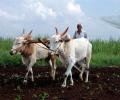
India needs to spread irrigation and do so against a backdrop of rising water scarcity and depleting groundwater resources
 © 2026 Rediff.com - Advertise with us - Disclaimer - Privacy Policy - Sitemap - Feedback - About us - Terms of use - Grievances